
The Leadership Habits Nobody Questions

A conversation I find myself having more frequently these days has nothing to do with communication, confidence, executive presence, or any of the topics people typically assume we're going to discuss.

More often than not, it begins with exhaustion.
Not burnout or overwhelm, just a quiet, persistent exhaustion that is difficult to explain because, on paper, everything appears to be working. The women describing it are successful. Their careers are advancing. Their businesses are growing. Their teams respect them. Their families depend on them. They are capable, accomplished, and doing many of the things they set out to do.
And yet, something feels heavier than it used to.
As I've listened to these conversations over the years, I've noticed an interesting pattern. The women describing this exhaustion are rarely struggling because they're doing something wrong. In fact, the opposite is usually true. They are often doing exactly the things that helped them become successful in the first place. They're:
Dependable
Consistent
Proactive
Responsible
Deeply committed to doing things well
These are qualities we admire. Organizations reward them. Teams appreciate them. Families often rely on them. Most leadership books would describe them as strengths.
And they're right.
The challenge is that strengths have a way of expanding beyond their original purpose.
At some point, many successful leaders stop consciously choosing these behaviors and begin identifying with them. Being dependable is no longer something they do. It's who they are. Being helpful is no longer a decision. It's an expectation they place on themselves. Being the person others can count on becomes so deeply woven into their identity that they rarely stop to question it.
That's where things become interesting.
One question I sometimes ask clients catches them off guard:
"What would happen if you didn't pick that up?"
Sometimes I'm referring to a project. Sometimes a problem. Sometimes an emotional burden that somehow found its way onto their shoulders.
The answer is rarely practical.
Very few people respond by saying, "Nothing."
Instead, they describe a feeling: discomfort, guilt, concern, or a sense that they're letting someone down.
What's fascinating is that, in many cases, nobody actually asked them to take responsibility for the thing they're carrying. They simply assumed responsibility because that's what they've always done.
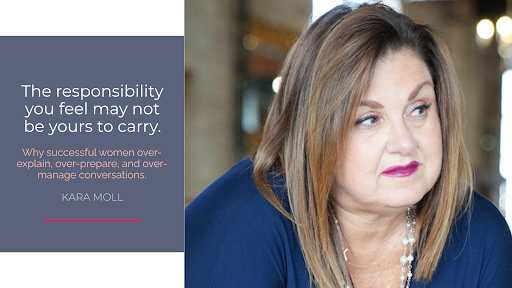
The more I think about it, the more I wonder how much leadership exhaustion comes from responsibilities we inherit rather than responsibilities we consciously choose.
Not official responsibilities, but psychological responsibilities. Responsibilities such as:
Making sure everyone is okay
Preventing problems before they happen
Smoothing out tension
Noticing what others miss
Holding everything together
Most of these responsibilities never appear on a job description. Yet they consume an extraordinary amount of energy.
What makes them particularly difficult to recognize is that they often look like leadership. From the outside, they appear responsible, supportive, and generous. From the inside, they can become exhausting.
Over time, many leaders become so accustomed to carrying these invisible responsibilities that they stop noticing the weight altogether. They simply assume leadership feels this way. They assume success requires this level of vigilance. They assume everyone else is carrying the same load.
Many aren't.
And that's worth paying attention to.
Beneath the Behavior
What I've learned over the years is that many of the behaviors we admire most are rarely just behaviors. They are often expressions of identity.
That's one of the reasons patterns like over-functioning can be so difficult to change. The challenge isn't simply that someone says yes too often or takes on too much responsibility. The challenge is that these actions are often connected to how they see themselves.
Many successful women have spent years becoming known as dependable, capable, and supportive. Those qualities become part of their professional reputation, but they also become part of their identity.
At some point, being helpful stops feeling like a choice and starts feeling like an obligation.
If being dependable is part of who I am, saying no can feel like I'm letting someone down.
If being supportive is part of who I am, allowing someone else to struggle can feel uncomfortable.
If being the person who always steps in is part of who I am, stepping back can feel irresponsible.
This is why so many leadership challenges resist simple solutions. We're not simply changing behavior. We're examining assumptions we've carried for years about what it means to be valuable, responsible, and successful.
Sometimes the behavior isn't the issue.
The behavior is protecting an identity.
And sometimes the most meaningful growth doesn't come from learning a new skill. It comes from questioning an old assumption.
One of the most important distinctions I've observed among strong leaders is the difference between being helpful and being responsible.
Helpful leaders support others.
Responsible leaders often carry others.
The difference sounds subtle. In practice, it changes everything.
Because the moment we stop assuming responsibility for every outcome, every problem, and every person's experience, we create space for something many successful women desperately need more of:
Capacity to think
Capacity to recover
Capacity to lead
Capacity to sustain success without sacrificing themselves in the process
Closing Reflection
This week, pay attention to the things you automatically pick up. The problem... The responsibility... The tension in the room.... The task that somehow became yours.
Before stepping in, pause and ask yourself:
"Did I consciously choose this responsibility, or did I simply assume it?"
Many of the responsibilities that exhaust us are never formally assigned. We inherit them through habit, identity, expectation, or a long-standing belief that it's our job to make everything work.
Sometimes leadership requires us to carry more. Sometimes leadership requires us to carry less. The wisdom is knowing the difference.
Success isn't usually the problem. Sustainability is.
About Kara
Kara Moll works with successful leaders who are succeeding by every visible measure and still feel heavier than they used to.
Her work sits at the intersection of performance, leadership, self-awareness, and human behavior. Rather than focusing on tactics or techniques, Kara explores the deeper patterns that emerge under sustained pressure: the responsibilities we assume, the expectations we normalize, and the identities we construct without realizing it.
Known for her ability to put words to experiences others struggle to articulate, Kara's coaching, writing, and speaking invite awareness before strategy and understanding before change.
Read her weekly essays in The Pressure Edit
To inquire about working with Kara: Contact Kara Moll


Comments